What Is a Hydrophore (Booster Pump) and Expansion Tank? Working Principle, Applications, and Choosing the Right Expansion Tank
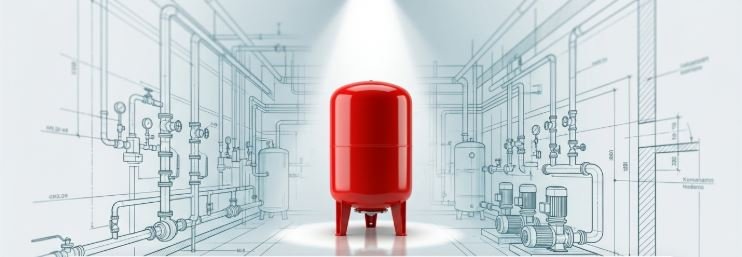
In modern buildings, industrial facilities, and large-scale infrastructure projects, controlling water pressure and ensuring the safe operation of heating systems are among the most critical aspects of mechanical installation engineering.
Especially in central heating, cooling, and water distribution systems, hydrophore (booster pump) systems and expansion tanks are essential equipment that ensure system efficiency, pressure stability, and operational safety.
A properly designed hydrophore (booster pump) and expansion tank system provides several important benefits:
- Balances water pressure
- Protects system equipment
- Improves energy efficiency
- Extends the lifespan of the installation system
In this article, we will examine in detail the working principles, applications, technical features, and proper sizing of hydrophore systems and expansion tanks.
What Is a Hydrophore System?
A hydrophore system (water pressure booster system) is a pump-assisted pressurization system that ensures water is delivered to usage points at a constant and sufficient pressure.
Hydrophore systems are widely used in the following applications:
- High-rise residential buildings
- Hotels and hospitals
- Industrial facilities
- Shopping centers
- Irrigation systems
A hydrophore booster system maintains water at a predetermined pressure level and prevents pressure fluctuations at consumption points.
A typical hydrophore system consists of the following components:
- Pump
- Pressure switch
- Pressure gauge
- Control panel
- Expansion tank
Among these components, the expansion tank plays a critical role in maintaining pressure stability within the system.
What Is an Expansion Tank?
An expansion tank is a pressure control device used in closed-loop water systems to compensate for the volume increase caused by temperature changes.
When water is heated, its volume increases. In closed systems, this thermal expansion can cause:
- Increased system pressure
- Stress on piping systems
- Pump and valve failures
An expansion tank absorbs this excess volume, maintaining the system pressure within safe operating limits.
For this reason, expansion tanks are commonly used in the following systems:
- Central heating systems
- HVAC applications
- Chiller systems
- Industrial process lines
- Hydrophore (booster pump) systems
How Does an Expansion Tank Work?
Modern expansion tanks are designed with a diaphragm or membrane structure.
Inside the tank there are two separate chambers:
| Chamber | Function |
|---|---|
| Water chamber | Stores the expanded water from the system |
| Gas chamber | Maintains pressure balance |
These two chambers are separated by a flexible diaphragm membrane.
During system operation, the process occurs as follows:
- The system water heats up
- The water volume increases
- The expanded water flows into the expansion tank
- The gas compresses and balances the system pressure
This process ensures that the system operates within a safe pressure range.
Advantages of Closed Expansion Tanks
Modern closed expansion tanks offer many advantages compared to traditional open expansion tanks.
Main advantages include:
- Maintains stable system pressure
- Prevents air formation in the installation
- Reduces corrosion
- Minimizes scaling and lime formation
- Improves energy efficiency
Additionally, closed expansion tanks eliminate problems commonly seen in open expansion tanks such as:
- Evaporation
- Freezing
- Water level reduction
Why Is Expansion Tank Selection Important?
Selecting the correct expansion tank size is essential for the safe and efficient operation of a system.
Incorrect tank sizing may lead to serious issues such as:
- Pressure fluctuations
- Safety valve activation
- Pump failures
- Damage to the piping system
For this reason, expansion tank selection must be based on proper engineering calculations.
How Is an Expansion Tank Calculated?
When determining the expansion tank capacity, the following parameters must be considered:
- Total water volume in the system
- Operating temperature
- Maximum system pressure
- Minimum system pressure
- Building height
These calculations can be performed manually or using engineering software tools.
For this purpose, the Expansion Tank Selection Program developed by Wenta helps determine the correct capacity quickly and reliably.
To use the program: Expansion Tank Selection Program
With this tool, engineers and project companies can easily determine the appropriate expansion tank by entering system parameters.
Where Are Hydrophore Systems and Expansion Tanks Used?
Hydrophore systems and expansion tanks are used across many different sectors.
Building Systems
- Residential projects
- Hotels
- Hospitals
- Shopping centers
Industrial Facilities
- Manufacturing plants
- Power plants
- Food production facilities
HVAC Systems
- Central heating systems
- Cooling systems
- Chiller systems
Frequently Asked Questions
What does an expansion tank do?
An expansion tank absorbs the volume increase caused by temperature changes in closed-loop water systems and stabilizes system pressure.
Why is a hydrophore system used?
A hydrophore (booster pump) system ensures that water reaches usage points with sufficient and constant pressure. It is particularly necessary in high-rise buildings to maintain pressure stability.
What happens if there is no expansion tank?
In systems without an expansion tank, pressure cannot be controlled effectively, which may cause damage to pipes and system equipment.
Conclusion
Hydrophore systems and expansion tanks are essential components for safe, efficient, and long-lasting operation in modern mechanical installation systems.
A properly sized expansion tank:
- Balances system pressure
- Improves energy efficiency
- Extends equipment lifespan
For professional projects, accurate engineering calculations and reliable equipment selection are extremely important.
Wenta expansion tanks, with their wide capacity range and durable design, offer reliable solutions for projects of different scales.
To determine the most suitable expansion tank for your system, you can use the Expansion Tank Selection Program or review the product page.